The Faceless Ones in Social Networking

As many of you would know, I’m an active networker, both online and offline.  I love connecting with people, learning things, sharing my own knowledge and experience and helping others move forward with their businesses.

There are times when I come across people who don’t really seem to get what networking is about.  For some it’s about how much business they can get, but they’re missing the other half of the equation – developing relationships and building a list of resources for their own businesses and for others they meet.  After all, networking is about building relationships and often you will benefit in the long term, if you refer people you meet to others you know… even if you get no business out of that meeting in the first instance.

What amazes me is that people often leave their profiles online incomplete, and for that matter, their business cards too. Why not tell the whole story? Make it easy for people to get to know you and contact you.

facelessOn some business cards people don’t include a postal address, just an email address and perhaps a phone number. Sometimes not even a surname – just a first name. If you don’t have a postal address you can share and don’t want to give your home address, then perhaps a suburb is useful. Some clients need to know roughly where you are before considering whether to do business with you. And the more you can tell them about you, the better.

And on social and business networks online it’s important for people to be able to identify you. That means adding a photo and letting people get to know who you are.  If you were meeting people face-to-face you wouldn’t hide your face. Well, you could try, but people would think you were weird and probably avoid you :-)   Online, if you’re in business, you need to make people feel comfortable with you, and especially with networks like LinkedIn, it’s important to complete your profile, share your past experience as this will validate what you are currently doing, and add your photo.  Old contacts will remember and recognise you, new people will recognise you if they later meet you in person, and over time, people feel they’ve gotten to know you. Which is what relationship building is about.  Using someone else’s image (like a famous person) or an animal or a cartoon really doesn’t cut it either. Let people see who you are as well as learn about the type of person you are through your profiles and contributions online.  These will help you build relationships and grow your business, over time.

I know when I get people asking to connect with me via LinkedIn, if they have no image and only a small number of connections, I will ignore them. If they have an image, even with low connection numbers I will take the time to read their profile and consider their request. But no photo and that indicates to me they haven’t completed their profile and they’re not yet ready to network.

Too old to be a VA?

Don’t you believe it!  I had a lady email me via LinkedIn during the week. She was feeling despondent and depressed because she wanted to work, had been classed as ‘disabled’ in her country and had good administrative skills but unable to get work.  She was just looking for something worthwhile to do and had been getting negatives from people around her and told me that being in the 50 plus age group had complicated things for her. This is my response to her.

I’m so sorry all of this has happened to you. For the record, I’m 55. tkThe oldest VA I know is in his early 80s, a delightful man named Terence Kierans, but whom we all lovingly call TK. He lives in Western Australia (http://www.linkedin.com/in/tkierans). We love him on our VA forum as he’s so knowledgeable and has a great sense of humour. Many others I know are in their 50s and 60s and weren’t much younger when they joined the industry. This industry is ideal for those who have years of experience behind them and wish to be home, for whatever reason. You included.

Feel free to email me direct and I invite you visit my site at http://www.vadirectory.net. We have a forum at yahoogroups with over 1400 members (from those learning about the industry through to those who are experienced) and you would fit in well there, I’m sure. Plus you’d learn heaps and be able to contribute too.

Middle aged woman at computerWhile new technology continues to develop, the internet itself has been around for some considerable time now.  There is absolutely no reason why anyone 50+ could not get involved in the VA industry, providing they have good administrative skills and know their way around a keyboard.  While it is true there are many who have grown up with computers and the internet and take to these things like a duck takes to water, that should not deter anyone in the latter years of their life who would like to become a Virtual Assistant.  I invite you to join our chat forum or send me a message to discuss.

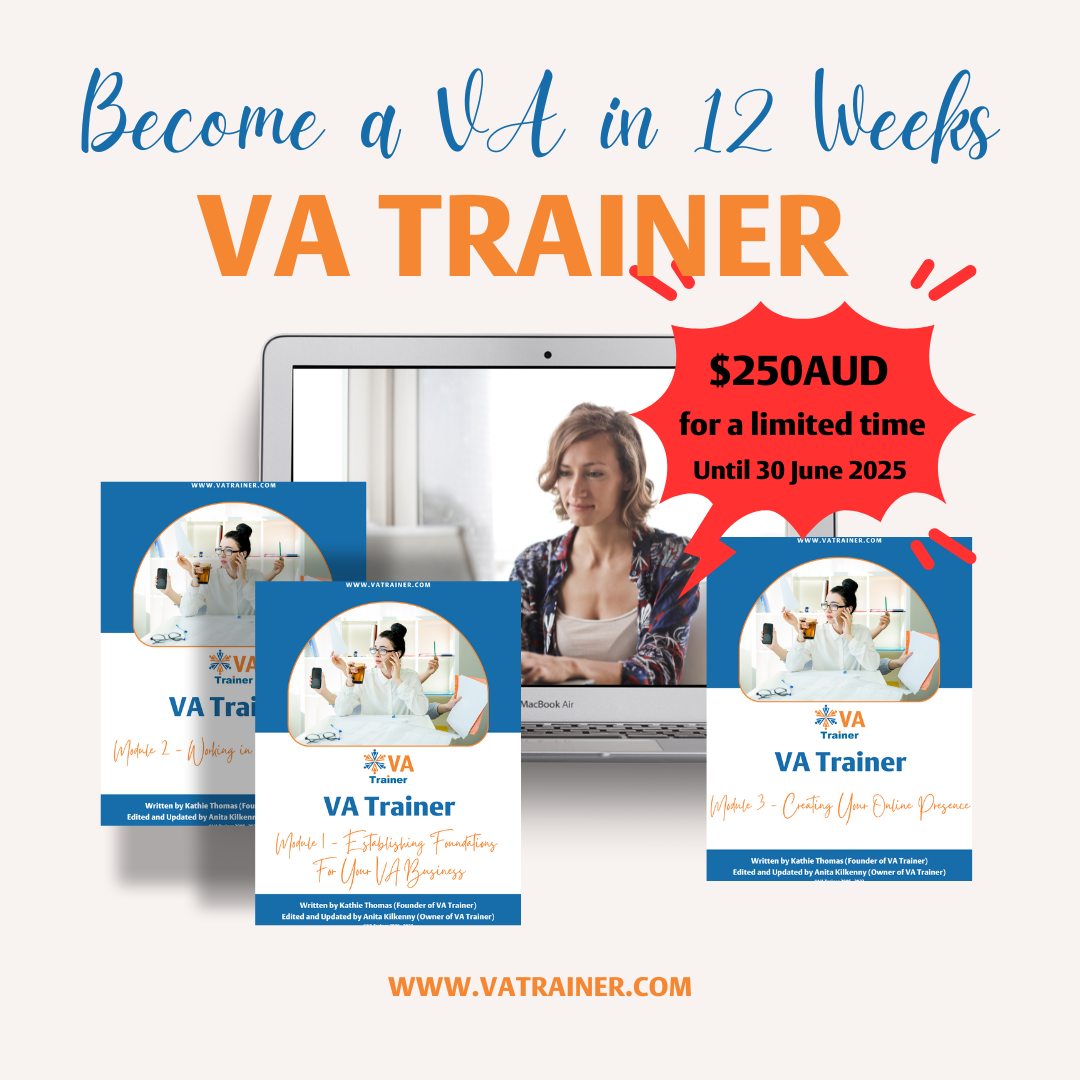
Since it’s close to the end of the financial year, I’d like to offer you the Virtual Assistant Trainer course at a special rate.  33% of the regular price will make it $450.00. For this month only. Click below to get started.

Buying a Virtual Assistant

Odd term, I know. But that’s what I saw recently in a forum.  A guy wanted to buy a VA for 8 hours a day, 5 days a week. He asked for the monthly rate. He was posting via a job forum because he wanted to get the VA direct rather than through an agency which doubles the charges (his words, not mine).

paymentThat made me wonder if people think engaging a VA through a VA Network means they’re paying higher rates and I want to let you all know that ‘no, you’re not’.  When a Virtual Assistant registers with a VA Network, they’re paying an annual subscription fee to belong to an industry based group.  That group or network manages the website and helps to promote the industry and their members through the funds that have been received by their paying members. At no time does the network charge clients for the right to search through their listings, website or for contacting a VA direct.  So, you can engage a VA without paying agency fees.

The situation is quite different if going through an agency.  Generally an agency is the employer of the VA in which case they are probably better called a ‘virtual worker’ rather than a Virtual Assistant. VAs are self-employed business operators, not employees. The agency sets the fee to be charged, selects which one of their virtual workers will be working on the job and invoices the client. They then pay their employee. So while you might have direct communication with the virtual worker, they’re actually employed by the agency.  As I’ve not worked for an agency I don’t know how long you can be with clients. I do know as a self-employed Virtual Assistant that I have serviced several clients over a period of many years and I get to choose which hours I work, what I charge, and the type of work I want to do. I enjoy the working relationships I have with my clients and the work that I do for them too.

If you are working with an agency do you know what you are being charged out at?  Are you under a contract that says you can’t source your own clients? Are you really being paid what you’re worth?  Something to think about.  The internet gives us a lot of flexibility and choices and it’s worth doing the research before committing to an agency – either as a VA or as a client.

Do you need a VA in your region?

One of the great things about VA Directories that are international is the ability to seek a VA in your own country or region.

Recent posts I’ve written have been about sourcing a VA in Australia (because that’s where I live) but what about in your own country, if you are elsewhere?  While it is true that a lot of work can be done by a VA anywhere in the world, there are also some good reasons why you might want to consider a VA in your own region.  And they include the following:

  • Being aware of the geographies of your country.
    If you need the VA to research venues, plan an itinerary, or answer calls that relate to districts and locations, then having a local VA makes a lot of sense.
  • The work needs to be done while you’re in your own office.
    Having a VA on the some timezone as you is ideal.
  • Anything relating to a legal nature, e.g. your IP.
    Sometimes it makes sense engaging a VA in your own country to protect your business and to ensure they are covered by the same legal structure as you.
  • Communication challenges
    There are just some things that need to be communicated in your own language and each country has its own nuances that can make the meanings of words quite different in other countries.
  • Understanding of how your tax system works
    If you need your bookkeeping done or other things relating to finances, it makes sense to have someone local look after it.

And I’m sure there are others as well. Such as cultural differences, or even an understanding of moral ethics can differ. Just sometimes the way you do things could be viewed in a very different way by someone in another country and it can generate a difficulty in communicating what you need or mean.  And the time differences, while it theoretically means that someone is working while you’re sleeping, can open the way to longer delivery times while waiting for answers or more direction on jobs being done.

When you are planning to engage a VA often it is the cost that seems to be most important to people, especially if they’re just starting out, or funds are tight, however, there are a number of other things to consider and it makes sense to think about these before making your choice.  And if you already do have a VA engaged, would you like to do this short survey for us please? We (the industry here in Australia) are seeking to learn more about how people source their VAs and the reasons for the decisions they make.

Where do you get your VA from?

There’s been interesting discussions in Australia and the US via the various VA forums, about businesses outsourcing offshore versus inside their own shores.  We feel that it is often important to do business with people who know how business is done in one’s own country, and all that entails with respect to legalities, taxes, IP, and so on for many of the services provided. Not all, but many.

A VA colleague recently came across an article in the US that discusses those same things and the concern for local jobs within their own shores because of the constant promotion about outsourcing offshore. Actually there are quite a few articles. When I began looking into it I found links for several others such as these here, here and here.  This Australian article is about what has happened to one bank in Canada due to their decision to offshore some of their workers. And here are some articles relating to businesses in Australia here, here and here.  The first discusses the pros and cons of off-shoring versus engaging in Australia.  Cost should never be the only factor the writer says. The last one raises an interesting point. If you are an Australian based VA and you are working with a team that are in different countries, what information is being sent where relating to your clients? And do your clients know this?  The reality is that technology is now global in many cases – our hosting, backup services and even software programs are in the cloud. But what about who is actually working on the documentation, databases, bookkeeping, etc? And who has access to what?  Are there the same concerns in other countries relating to this?

This article talks about what we can learn from India and what they are doing. It also raises about the changes happening here in Australia and involvement from our government.

I agree that there is room for off-shoring some services but find comments that they couldn’t find anyone here in Australia difficult to comprehend, or that they’re a brand new business and can’t afford to pay Australian rates. All of us have been brand new in our businesses at some stage and have had to engage support here in Australia to help us get things going. I’m sure this is the same for those in the US, Canada, UK, New Zealand and elsewhere. In this case I’m speaking about the Virtual Assistant industry and related industries of bookkeeping, graphic design, web design, transcriptions, and so on.  If you Google “Australian Virtual Assistant” or “Virtual Assistant Australia” there are lots of references to Australian based VAs, their networks and their Industry Association. So I have no idea what potential clients may be searching on if they’re not finding Australian based VAs. And if you’re a brand new business it’s important to think about how you’re going to build your business here locally. Are you networking, meeting people face-to-face and building a support team around you as well as a set of resources?  Are your own potential clients local or overseas? Engaging local support will help widen your local business circle and many VAs help their clients to make connections in many different ways.  Remember, while I’m talking about Australia above, this very much applies to any country where the Virtual Assistant industry is present.

So, going back to my original question. And this is a message for anyone in any country – not just Australia. This post is directed at those who engage Virtual Assistants to assist in the daily running of their businesses. Where have you sourced your VA from? And if you chose to source a VA outside of your own country, why was that?  Share with us here the difficulties you might have faced trying to find someone locally (if that applies) and likewise, those who do use local VAs (irrespective of which country you’re in) how did you find your VA? Was it word-of-mouth? A Google search?  An article or something else?

I’ve created a Survey on this topic that covers the above questions and more, and invite you to participate. Just 10 questions – so it should only take you a minute or less.  I’ll share the results in a few weeks.

Powered by WishList Member - Membership Site Software